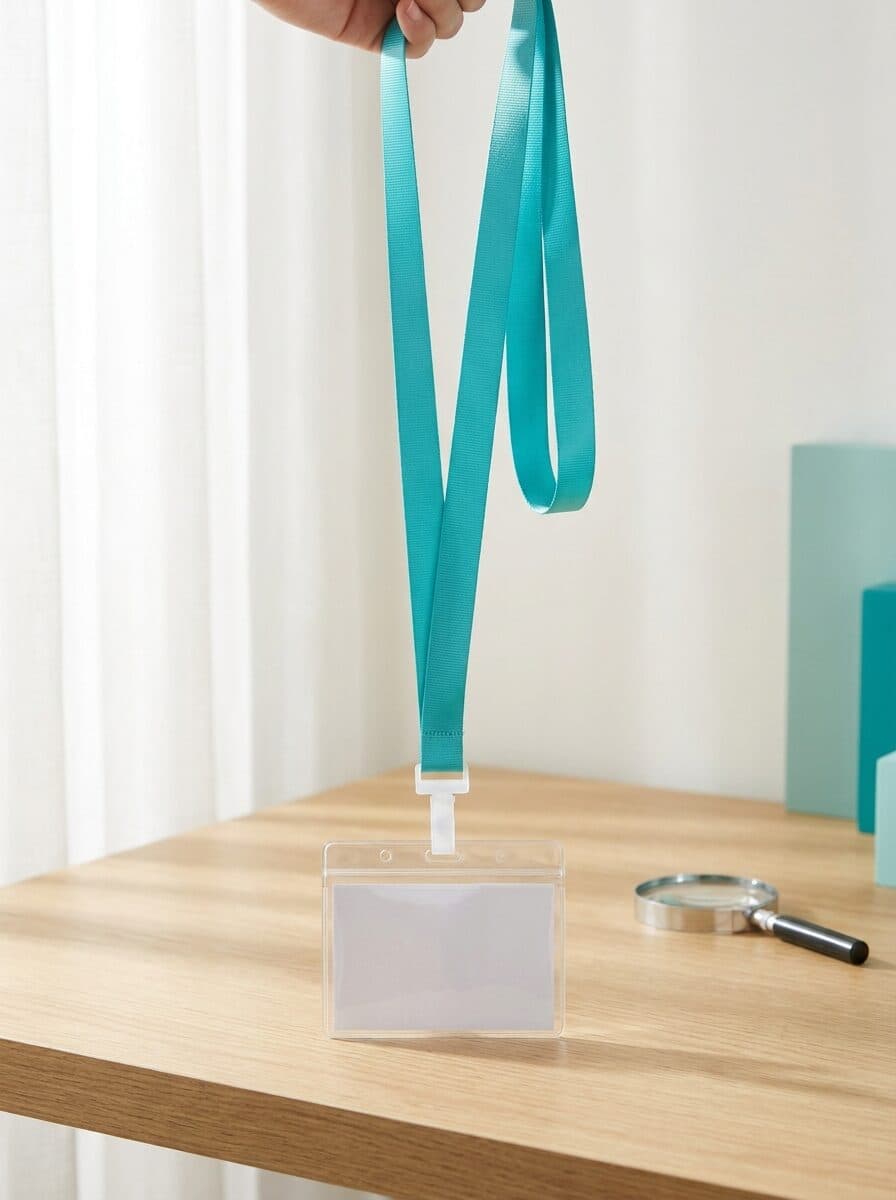
Why does choosing a staff ID lanyard feel hard?
An employee ID strap is both a small piece of company branding and a practical item worn daily. Too cheap a material and it snaps within six months; too expensive and it blows the budget. That is why HR and admin buyers can feel unsure where to start on a first order.
A staff strap is usually used for a year or two, with top-up orders at each intake and reorganisation. Getting the material, width, and hardware combination right at the start makes every reorder easier. A spec chosen in a rush, by contrast, becomes a puzzle to solve every time.
This guide explains material, width, hardware, print method, and lead time in practical terms for buyers ordering staff straps for the first time or replacing an existing product, along with budget planning, the ordering process, and common questions. Read it in order and you’ll naturally know what to prepare when requesting a quote.
1. Material: nylon vs polyester
For an item worn every day, durability comes first. Nylon has a smooth, glossy surface that looks premium and resists abrasion, so it suits long use. Polyester is cheaper than nylon and optimised for full-colour (dye-sublimation) print, so it’s preferred for complex logos or gradient designs.
In more detail, nylon feels smooth and lets colour sit calmly, suiting executive or premium brand imagery. But for bright colours or photographic images by dye-sublimation, polyester is better. Among polyesters, tightly woven fabric has little lint and high print sharpness, and is the most common choice for staff straps.
In short: for a single-colour, simple logo needing a premium look, choose nylon; for full-colour or gradients, or when cost efficiency matters, choose polyester. Either way, a heavier, thicker fabric resists creasing and stretching through a full day of wear.
2. Width: 10mm / 15mm / 20mm
Width directly affects comfort and how much print area you have. 10mm is thin and light for a minimal look but hard to fit a large logo on. 15mm is the most common standard for company straps and comfortably holds most logos and company names. 20mm and up is wide enough to print a large logo or slogan and is popular for events and trade shows.
When choosing width, consider your logo’s aspect ratio. A wide logo fits 15mm fine, but a near-square logo, or one that includes the company name, reads better at 20mm. Conversely, IT firms and startups wanting a thin, refined look sometimes prefer 10–12mm.
Check your ID card-holder clip spec in advance. If the strap is wider than the holder, the clip may be loose; if narrower, the join can be too tight and awkward to detach. If you plan to reuse existing holders, measure the inner width of the holder clip and tell us, and we’ll suggest a strap width that fits exactly.
3. Hardware: hook + safety buckle
Hooks are mainly metal clips (bulldog or toggle) and D-rings. For corporate use, a zinc-alloy metal clip with a matte black or silver finish is cleanest and durable. Plastic hooks cost less but are weaker under repeated attaching, so for daily clip-on and clip-off use we recommend metal.
If several cards are attached, a swivel hook keeps the strap from twisting. If you plan to hold an access card and an ID together, or to add a badge reel, tell us in advance — comfort and price change with the hardware combination.
A safety breakaway buckle is essential. Fit a buckle that releases above a certain force so that if the strap catches on a door handle, drawer, or machine, no load is placed on the neck. It is a recommended configuration for occupational safety, especially on production floors or in hospitals where snagging is a risk.
4. Logo print method
Most companies hold their logo as a vector file (AI, SVG, PDF), which silk-screen prints crisply. For a single colour or 2–3 colours, silk-screen is the sharpest and most economical. For a full-colour logo, gradients, or a full background colour, choose dye-sublimation, where the ink permeates the yarn.
Different methods need different files. Silk-screen prefers a vector file with clear colour separation; dye-sublimation prefers a high-resolution image. If you have only an image (JPG or PNG) and no vector, production is still possible — we’ll check the resolution first so the logo edges don’t blur.
If your logo colour is specified as a Pantone code, be sure to tell us — accurate colour matching keeps your brand consistent. If there’s no Pantone code, we match the closest yarn and ink to your existing printed material or brand guide.
Q. Can you match our corporate CI colour exactly?
A. If you provide the Pantone code, we match the closest yarn or print ink. For an exact Pantone match, we recommend confirming a sample first.
5. Lead time and notes for bulk orders
Demand for staff straps peaks in the new-hire seasons. During those periods the production schedule fills quickly, so completing your order at least three weeks ahead is safe. The flow is proof approval → sample check → bulk production, so if you also want a sample, allow extra time.
For bulk orders, the unit price falls as the quantity band grows. Tell us the quantity you need and your budget range, and we’ll adjust the material-and-hardware combination to propose the best terms. Splitting colours by department or specs by rank is also easy to manage when ordered together, and better on price.
6. Budget planning: what determines the unit price
The unit price of a staff strap is set by a combination of factors: material (nylon or polyester), width (10–20mm), print method (silk-screen or dye-sublimation), number of print colours, hardware (hooks, buckles, swivels, badge reels), and total quantity. The same design varies in price by this combination, so if you have a set budget, it’s wise to have the most efficient configuration proposed within it.
The surest way to save is to standardise the spec in advance. A single-colour logo with 15mm polyester, a metal clip, and a safety buckle balances durability and cost well, and is a common base spec for company straps. Whether to add full colour or special hardware is then decided by brand image and budget.
Q. What do I need to prepare to get a quote?
A. Just your logo file (vector if possible), the quantity you want, a rough width and colour, and your target delivery date. Even if the details aren’t set, give us the purpose and budget and we’ll propose a suitable configuration.
Q. Can you produce in small quantities?
A. Small runs are possible. The minimum can vary with the print method and hardware, so tell us your desired quantity and we’ll advise the right approach.
7. The ordering process at a glance
The overall flow is (1) quote enquiry (share purpose, quantity, logo, target date) → (2) spec confirmation and quote reply → (3) design proof check → (4) optional physical sample check → (5) bulk production → (6) inspection and delivery. The time you take to review and reply at each step adds directly to the overall lead time, so allow for internal approvals to avoid missing your deadline.
If you’re ordering for the first time, checking colour and logo position carefully at the proof stage matters most. If you’re worried about on-screen versus real colour, we recommend a sample before bulk production. Leave a quote enquiry or a callback request with any questions and we’ll guide you through in order.
Q. How long does the lead time usually take?
A. It varies by spec, quantity, and season, but production usually takes about 2–3 weeks after the proof is confirmed. If you check a sample first, that time is added, so enquire well ahead of when you need them.
Q. Can you remake an existing strap exactly?
A. Yes. Tell us the width, material, and hook type of the existing product and your logo file, or send a photo of the item, and we’ll reproduce it as closely as possible for your reorder.